

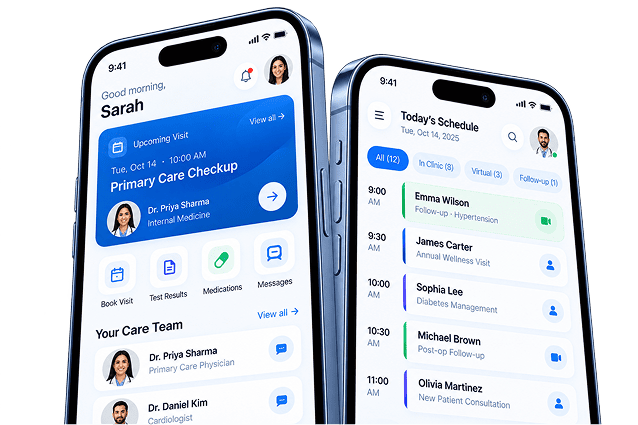
Building a New Patient or Clinician App
A greenfield build for a provider, payer, or digital health startup, designed around the workflows your users follow.

 Mobile App Development for Healthcare
We build iOS, Android, and hybrid healthcare apps, from telemedicine to remote monitoring, for providers, payers, and HIT Vendors
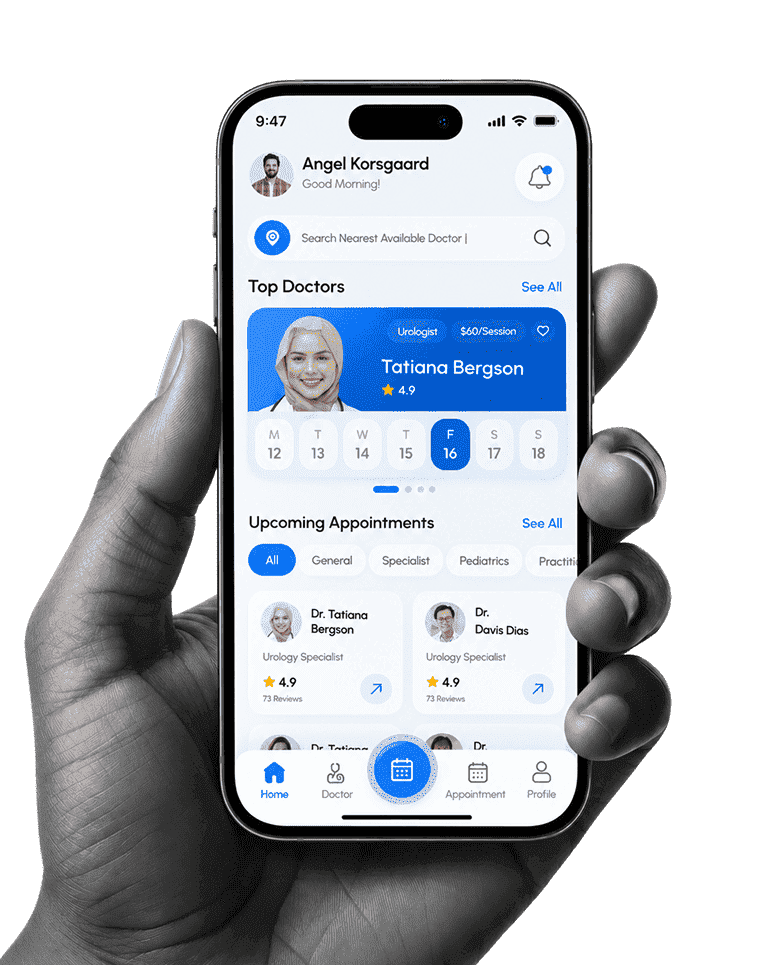
What are you trying to do?
A greenfield build for a provider, payer, or digital health startup, designed around the workflows your users follow.
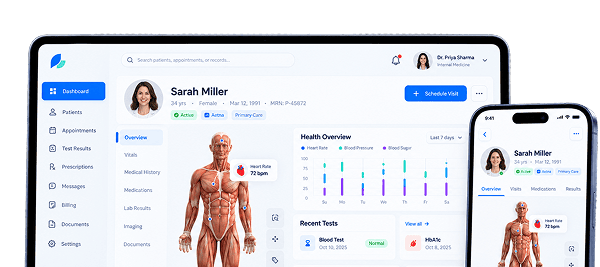
For HIT vendors and ISVs who already have an EHR, PMS, or product and need a mobile companion, not a rebuild from scratch.
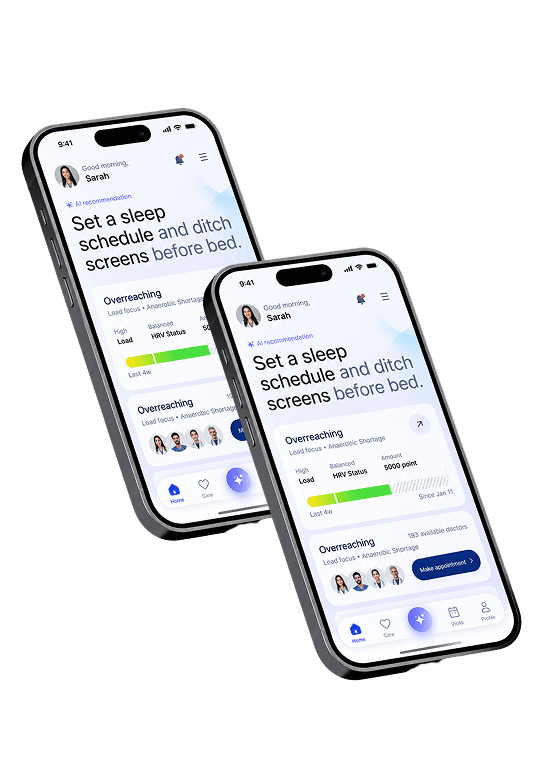
An existing app that needs a UX refresh, a platform update, or an architecture overhaul to keep up with current expectations.
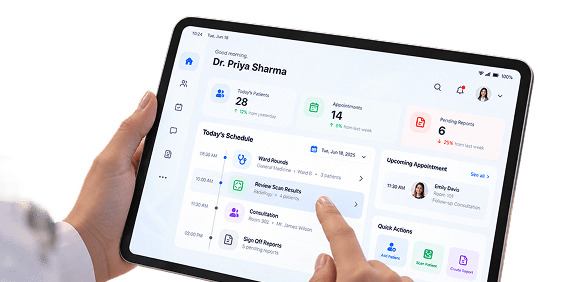
Hospital-issued devices, cost-sensitive rollouts, or environments where Android is the only realistic option.
What we consider on every build

We bridge the gap between business goals, user needs, and what the app has to do in a clinical or administrative setting.

Patient data is protected during access, storage, and sharing, at every layer of the app.

We build to federal and state requirements governing ePHI and healthcare data handling. Full framework detail is in the Compliance section below.

Interfaces are designed for minimal effort, built around how patients and clinical staff work, not how an org chart is structured.

Apps connect to medical devices and existing healthcare systems using recognized interoperability standards.

Our iOS and Android developers manage platform selection, app store publishing, DevOps, and release management from build through launch.

 Regulations
Security and Privacy
User Experience
Who uses this


What we've built before

Virtual consultations through video, chat, or voice, with prescriptions and referrals handled without an in-person visit.

Mood tracking, guided relaxation, CBT tools, and access to counseling and therapy support.

Scheduling, availability, reminders, cancellations, and directions to the facility, all in one place. This is one of the two most common builds we take on, alongside the staff-facing check-in tools below.

Coverage management, claims status, benefits, in-network provider search, and digital insurance cards.
Medical history, medications, allergies, and lab results, stored and shareable with providers on request.

Blood pressure, blood sugar, heart rate, sleep, and activity, with personalized insights from the data.
Access, manage, and update medical histories, diagnoses, prescriptions, and treatment plans from a mobile device.
Drug databases, clinical guidelines, and decision-support tools for evidence-based care.
Scheduling, patient communication, and staff coordination for day-to-day practice operations.
Secure communication of patient health information across providers for coordinated care.
Symptom checks, drug interaction checks, and diagnostic algorithms that support accurate treatment planning.
Risk classification, care coordination, and analytics for proactive population health.
Mobile apps that pair with wearables, remote monitors, or diagnostic hardware to stream and display device data to patients and care teams. Apps connected to a regulated device carry their own considerations on top of HIPAA and HITRUST, covered in the Compliance section below.
For HIT vendors and ISVs
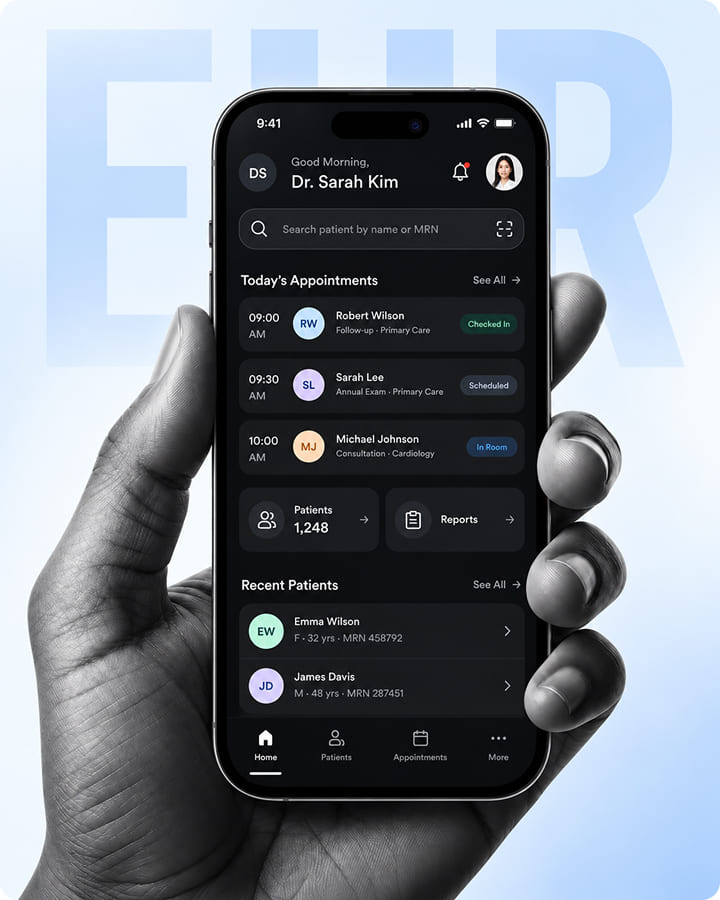
Most healthcare mobile app projects get talked about as if they start from a blank screen. A lot of real engagements don't. If you're a HIT vendor or ISV, the more common need is adding mobile to a product that already exists, with an existing data model, existing user workflows, and an EHR or PMS backend that the new mobile experience has to talk to correctly.
That kind of work is different from a greenfield build. It means preserving the UX your users already know, converting mobile input into the formats your backend already expects (XML, HL7, FHIR), and shipping without disrupting a product that's already live and in use.
If your backend also needs cloud modernization alongside the mobile extension, our healthcare cloud managed services cover migration and ongoing operations for the same kind of platform.
Talk About Extending Your Platform
iOS, Android, and everything between
The right platform depends on your users, your integration needs, and whether you're building new or extending something that already exists.
| Platform | Best when... | Core tech |
|---|---|---|
| Native iOS | Provider- or clinician-facing apps that need deep device integration and top-tier performance | Swift |
| Native Android | Hospital-issued or field devices, cost-sensitive rollouts, Android-first environments | Kotlin |
| Hybrid | Extending an existing platform to mobile without a full native rebuild | Ionic |
| Cross-Platform | Patient-facing apps that need iOS and Android from a single codebase, on a faster timeline | Flutter, React Native |
Where AI helps
AI works best in a healthcare app when it supports the people using it, rather than adding complexity for its own sake.
Content, reminders, and in-app flows tailored to a patient's specific condition or care plan.
Surfacing patterns such as missed-medication risk or readmission risk for care teams, directly inside the app rather than buried in a separate report.
Symptom-intake assistants and guided Q&A flows that help a patient describe what's going on before they ever reach a clinician. Assistive, not diagnostic.
AI-assisted extraction from intake forms or scanned records, converting unstructured input into data your EHR can use.
Scheduling, care coordination, and follow-up reminders handled automatically inside the app instead of manually by staff.
Built to the standard, not around it
Compliance isn't a review step we run at the end. It's a design input from the first architecture decision.
 HIPAA and HITRUST
Patient data handling, access controls, and audit trails aligned to HIPAA and HITRUST from day one.
FHIR and HL7Interoperability standards for exchanging data with EHRs and other healthcare systems.
Meaningful Use, PI, ACI, MACRA, and the Cures ActDirect experience helping clients align with the regulatory programs that have shaped US healthcare IT over the past decade.
For Connected Medical DevicesApps that pair with a regulated device carry FDA software-as-a-medical-device considerations on top of the standards above. We account for that from the design phase, not after the fact.
Case studies
Healthcare · Chiropractic EHR
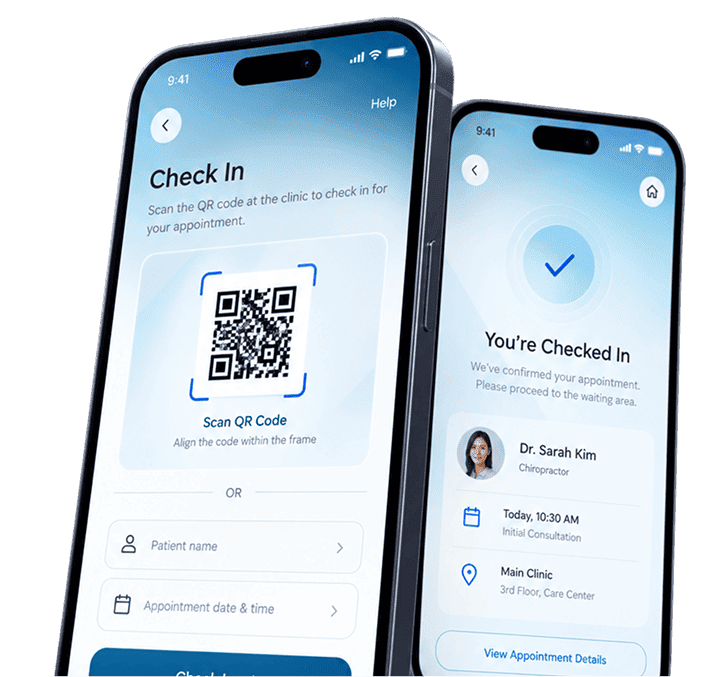
Kiosk-based admission moved to a QR-code mobile app for a vendor serving 7,000+ chiropractic facilities, without disrupting the live EHR platform.
Key outcomes
Healthcare · Behavioral Health EHR
Twilio-based video visits integrated into an existing EHR's appointment calendar, supporting HD group therapy sessions during the pandemic.
Key outcomes
What clients say

Nalashaa stepped in to support design and programming at a critical stage, and it proved to be the right decision. The team delivered outstanding work and helped move the product closer to launch.
 Michigan, USA

We have trusted the Nalashaa team with complex projects that our senior developers did not have the bandwidth to take on. They take time to understand requirements and approach estimates thoughtfully.
USA
Nalashaa has become part of our business strategy because of their domain expertise, flexibility, and the ease of working together.
Idaho, USA
Why Nalashaa



We understand objectives and user personas, design features, build wireframes for feedback, and finalize technical specifications.

We build an MVP, gather feedback, implement the full product, and verify application behavior before moving forward.

We publish for user acceptance testing, incorporate feedback, run a general-availability flight test, and then publish for full release.

We diagnose usage patterns, apply fixes and enhancements, gather ongoing feedback, and keep optimizing after launch, not just at handoff.
Get started
Planning a patient app, a clinician tool, or a connected health platform? Most teams start by reviewing user workflows, integrations, and compliance needs. We can help you validate scope and timelines before development begins, and get back to you within 24 hours with next steps.
 Your details stay confidential.
Questions we hear
Telemedicine. Remote video, chat, or voice consultations remain the single most-used feature across healthcare mobile apps, largely because they solve the biggest pain point directly: getting care without an in-person visit.
Yes. Security and HIPAA compliance are priorities from the first design decision, not a review step added at the end. We adhere to the regulations that govern healthcare information at every stage of development.
It moves administrative and clinical tasks onto a device people already carry: tracking health issues, accessing records, scheduling care, and communicating with a care team, without adding a new piece of hardware or a separate login system.
Typically four to six months, depending on app type, feature scope, platform choice, and development approach. Extending an existing platform is usually faster than a greenfield build.
Yes. This is a common starting point for HIT vendors and ISVs specifically. We work with your existing data model and backend rather than starting over, as covered in the Extending Your Platform section above.
Both. We build native Android apps in Kotlin for field, hospital-issued, and Android-first environments, and cross-platform apps in Flutter or React Native when a shared codebase across iOS and Android is the better fit.
Yes. Personalization, predictive risk signals, clinical document processing, and workflow automation are all things we build into mobile apps today, detailed in the AI Features section above.
Cookies help us deliver our services. By using our services, you agree to our use of cookies Privacy Policy.

