


Claims processing platforms
Adjudication logic, auto-adjudication rates, pended claim workflow, edits and rules maintenance

Engineering for US health plans, from interoperability and prior authorization APIs to claims, core administration systems and analytics.
Talk to a Payer Technology Specialist
Compliance deadline
The regulatory picture moved, and most payer roadmaps were scoped before it did.
CMS-0057-F requires impacted payers, meaning Medicare Advantage, state Medicaid and CHIP, Medicaid and CHIP managed care, and qualified health plans on the federal exchanges, to run Prior Authorization, Patient Access, Provider Access and Payer-to-Payer APIs.
Decisions inside 72 hours for expedited requests and 7 calendar days for standard ones, specific reasons on every denial, and public reporting of prior authorization metrics.
Standards
CMS will not enforce the X12 278 requirement against a payer running an all-FHIR Prior Authorization API. FHIR only, X12 only, or both are permitted. The standard became a design decision rather than a given, and most plans are making it with a team that knows one side or the other.
Compliance deadlines
| CMS-0057-F operational rules in force | January 2026 |
| CMS-0057-F API compliance | 1 January 2027 |
| CMS-0053-F effective | May 2026 |
| CMS-0053-F compliance | May 2028 |
| X12 5010 to 7030 | In rulemaking |
Our services
Start with the problem you have, not the service you think you need.
FHIR APIs for CMS-0057-F, TEFCA participation, and the data work underneath them. Where most payer roadmaps currently have a gap.
→ Healthcare interoperability solutions837, 835, 834, 270/271, 276/277 and 278 across implementation, integration, testing and analytics, alongside the FHIR path.
→ EDI services for health plansRisk adjustment, HEDIS and NCQA reporting, network performance, utilization trends, and member risk views
→ Healthcare payer analytics solutionsClaims, enrollment, benefit administration and provider data platforms, built new or modernized in place.
→ Custom healthcare software developmentAuto-adjudication, prior authorization workflow, provider network onboarding, and the claims edit that still run through manual review.
→ Healthcare automation servicesCMS interoperability reporting, prior authorization audit trails, HIPAA-aligned X12 and FHIR transactions, and the documentation your regulators and auditors will ask for
→ Healthcare compliance consultingCore systems
Most health plans run on a core admin system too embedded to replace outright. We build around it rather than against it, layering new capability without disrupting claims, enrollment or provider data.
Adjudication logic, auto-adjudication rates, pended claim workflow, edits and rules maintenance
834 processing, member records, reconciliation, effective dating
Plan configuration, premium billing, benefit rules
Provider directories, network and contract data, credentialing feeds
Self-service applications, provider portals with automated adjudication, secure member access
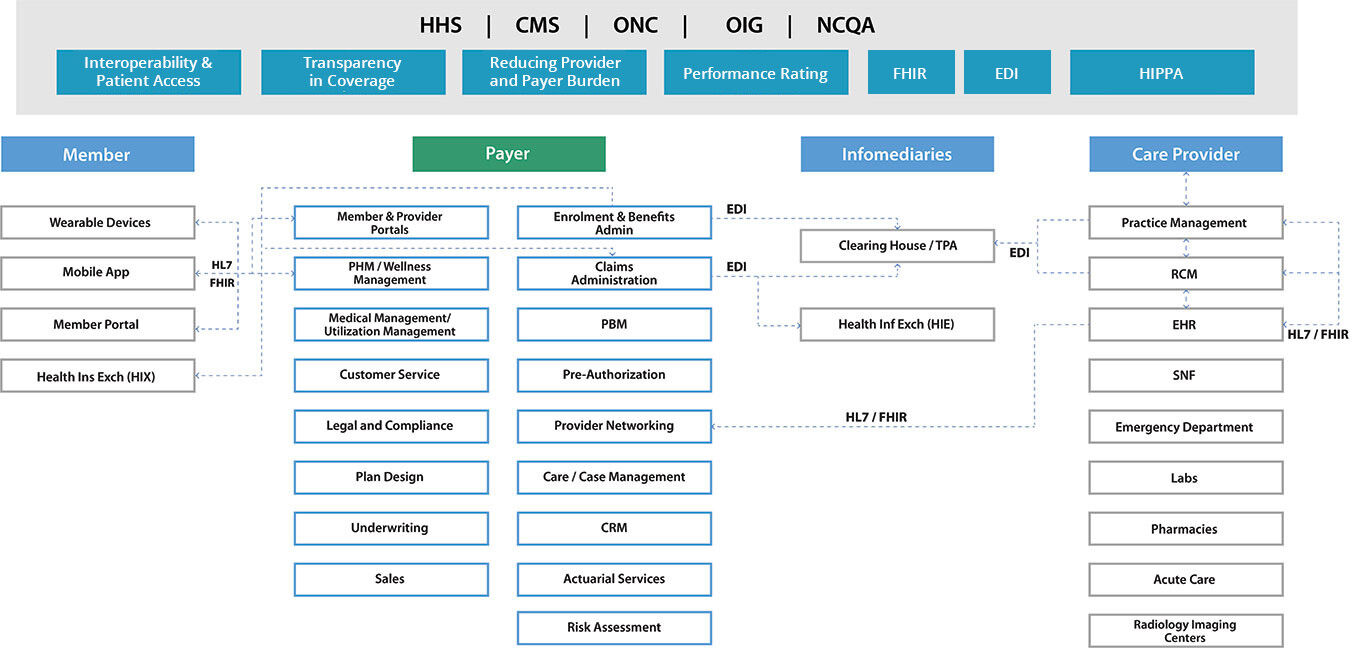
APIs and services connecting core admin to portals, clearinghouses, vendors and the FHIR endpoints CMS now requires
We document and reverse-engineer what exists, build an integration layer with defined services, then deliver portals, APIs and workflows against that layer rather than against the core directly.
The core stays stable, the new work stays maintainable, and the two can move on different schedules. This includes older stacks. If your claims or enrollment platform predates the team maintaining it, that is a common starting point rather than an unusual one.
The same FHIR and HL7 work CMS-0057-F now requires of payers, delivered under comparable regulatory pressure.
A fertility EMR vendor serving 120+ clinics was paying around $30,000 for every new vendor integration, and had 120 more waiting. Four engineers changed the math in four months.
Read the case study
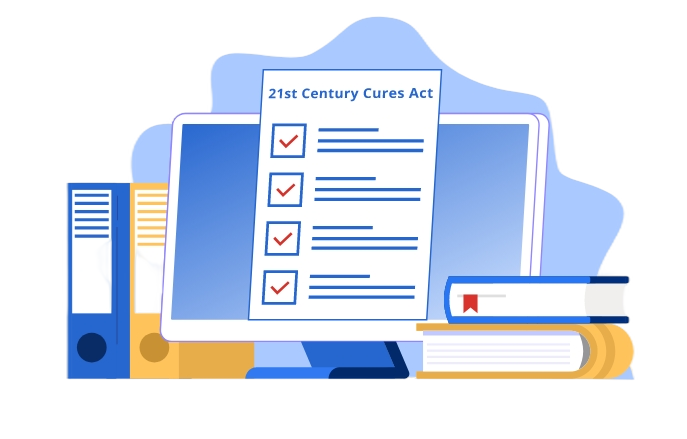
An oncology health IT company faced proposed penalties of a million dollars per violation and a certification deadline that would not move. 27 US Core profiles later, they cleared it.
Read the case studyAn ambulatory EHR vendor expected a rebuild. Discovery found the HL7 v2 infrastructure did not need replacing — the same question most payers are asking about their own core systems right now.
Read the case study
We have also automated eligibility verification, claims status checks, EOB data entry and payment posting for RCM companies and provider organizations.
Why Nalashaa
What you should expect from a payer technology partner, and what most do not offer.

We do not split attention across industries. Every engagement is a US payer, provider, HIT vendor or medical device company.

X12 and FHIR are delivered by the same engineering group, so the recommendation is not shaped by the only standard we know.

Documentation, version control and no tribal knowledge held back. You own what we build, with no lock-in.

You get an engineering team that knows your systems, not a rotating bench. On payer platforms, continuity is what keeps a modernization from stalling.
HIPAA, GDPR, NCPDP, FDA, ONC, MDR, SAMHSA, IVDR, MACRA, MIPS, CEHRT, SAFER and HTI-1.
HL7, FHIR, X12 EDI, ICD-10, LOINC, CPT, XDS/XDS-I, DICOM, CDA and CCD.


Process and engagement
No proposal before anyone has looked at your systems.
What you run, what is failing, and what the compliance calendar looks like from where you sit. Around 45 minutes.
Current data flows, integration points, transaction volumes and where manual work has accumulated.
What we found, what we would do, in what order. Yours whether or not you engage us.
Starting with what is failing most expensively.

Work with us
Planning for interoperability and prior authorization APIs, modernizing a core administration platform, or working out where to start?
Free consultation
No obligation and no sales sequence. If we are not the right fit we will say so.
Ask whether they work in US healthcare only or split attention across industries. Ask whether the same team delivers X12 and FHIR, because a partner who knows one will steer you toward it. Ask what they hand over at the end, and whether you can maintain it without them.
Usually through an integration layer rather than direct changes to the core. Defined services sit between the core administration platform and everything else, so portals, APIs and vendor connections are built against that layer. The core stays stable and the new work stays maintainable.
For prior authorization, CMS has said it will not enforce the X12 278 requirement against a payer running an all-FHIR Prior Authorization API. FHIR only, X12 only or a combination are all permitted for that transaction. Every other HIPAA-mandated transaction remains X12, so most plans will run both for some time.
Usually it does not need replacing. We document and reverse-engineer what exists, then build modern services and interfaces around a back end that stays in place.
Claims adjudication, enrollment and eligibility, benefit configuration and premium billing, provider data and network management, and the member and provider portals that sit on top of them.
X12 837, 835, 834, 270/271, 276/277, 278, 820 and 275, plus HL7, FHIR R4, US Core, CDA and CCD.
Risk adjustment, HEDIS and NCQA reporting, network and provider performance, utilization and cost trends, denial patterns and member risk stratification.
Encryption in transit and at rest, role-based access control, audit logging, and documentation aligned to HIPAA built as part of delivery rather than added afterwards.
A conversation with an engineer, then a review of current systems, then a written summary of findings and recommended sequence. The summary is yours whether you engage us.
Cookies help us deliver our services. By using our services, you agree to our use of cookies Privacy Policy.
