

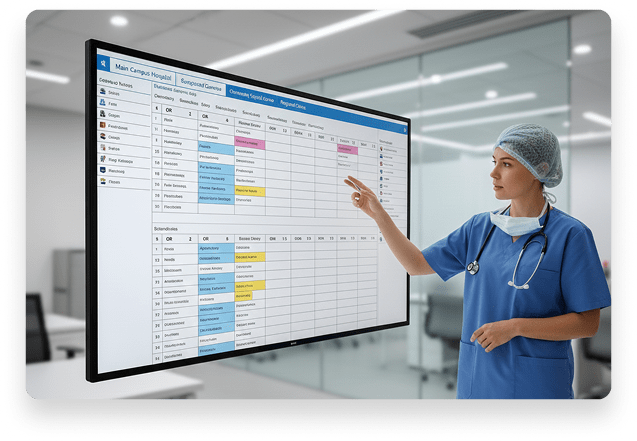
A leading healthcare technology firm set out to develop a next-generation surgical scheduling platform to unify appointment coordination across hospitals, ambulatory surgical centers, and specialty clinics. The goal was ambitious: allow physicians to manage surgeries across multiple facilities without administrative silos, security trade-offs, or workflow disruption. This case study explores how we architected multi-tenancy from day one to support a scalable, secure, and flexible scheduling experience tailored to real-world workflows.
Engineering Multi-Tenancy into a Surgery Scheduling Platform
A case study on building a multi-tenant, HIPAA-compliant scheduling system for modern healthcare facilities
Introduction
The Challenge
A Vision Beyond Single-Facility Scheduling
In modern healthcare, physicians rarely operate within a single hospital or clinic. They juggle responsibilities across networks of surgical centers, making fragmented scheduling tools a serious bottleneck. The envisioned platform had to support a unified view of appointments across multiple, unaffiliated organizations before the first user even logged in.
Role-Based Access for Extended Teams
Doctors rely on their administrative teams, often across different locations to manage their schedules. The system had to be designed with built-in support for sub-users who could act on behalf of the doctor, with clearly scoped access rights.
Future-Proof Scalability
The solution had to be scalable by design, capable of handling hundreds of facilities, thousands of users, and potentially millions of appointment records without compromising speed or performance.
Compliance Starts at the Foundation
As this would be a cloud-based healthcare platform, strict boundaries were needed between tenants (facilities) to ensure data privacy, comply with HIPAA, and build user trust from day one.
Why Multi-Tenancy Was Non-Negotiable
Why Multi-Tenancy Was Essential
Before a single line of code was written, it was clear this product needed to accommodate a future where:
Doctors are affiliated with 2–10+ facilities.
Administrative staff often act on a physician’s behalf.
Regulatory boundaries (like HIPAA) demand rigorous tenant isolation.
Designing for single tenancy would create scaling bottlenecks, increase costs, and force major rework in future phases. Multi-tenancy wasn’t a feature—it was foundational.
Our Solution
Architecture & Approach
To meet the client’s vision, our engineering team built a cloud-native, multi-tenant architecture from the ground up embedding scalability, security, and role-based control at every layer. The solution rests on four architectural pillars:
Facility-Aware Scheduling Logic
Built a tenant-aware scheduling engine that dynamically identifies facility context while presenting physicians with a single, unified dashboard to manage appointments across all associated facilities.
Hierarchical User Roles and Permissions
Implemented role-based access control that allows doctors to delegate scheduling and administrative tasks to sub-users with tightly scoped permissions, maintaining oversight without compromising security.
Containerized Multi-Tenant Architecture
Designed a multi-tenant platform using containerized microservices, enabling each facility to operate within its own logical tenant while allowing new clinics to be onboarded quickly and efficiently.
Scoped and Encrypted Data Partitions
Implemented logically isolated database partitions with encryption at rest and in transit, ensuring strict tenant-level data boundaries and compliance with healthcare data protection standards.
Key Features Delivered
What We Delivered
The multi-tenant architecture and role-based design translated into tangible, high-impact outcomes for users and administrators.
Unified Scheduling Across Facilities
Physicians can manage appointments across multiple hospitals and centers from a single dashboard, eliminating visibility gaps and reducing administrative burden.
Delegated Access Control
Administrative users can manage schedules on behalf of doctors using only the permissions required for their role, improving efficiency while preserving control.
Scalability from Day One
The platform is designed to scale without major redesign, supporting rapid growth and high-volume scheduling with consistent performance.
Enterprise-Grade Security
Multi-layer security ensures compliance and peace of mind, with strict tenant data segregation and continuous access monitoring across facilities.
Benefits of Our Solution
Measurable Outcomes
The system is already delivering performance and scale across real-world healthcare environments.
100,000+
Appointments Managed
Live production records
3
Facilities Supported
Without refactoring
<1s
Response Time
Under high load
~2 min
Facility Onboarding
Average setup time
Conclusion
Strategic Takeaway
By embedding multi-tenancy and role-based access controls into the core design of the surgical scheduling platform, the development team ensured that the product could meet complex real-world needs from day one. This forward-thinking approach positioned the platform to serve modern healthcare practices operating across multiple locations, offering scalability, security, and user empowerment as foundational capabilities.