

Reducing Chart Review Time by 30% Using NLP
How a mid-sized multi-specialty provider group cut pre-coding chart review time with clinical NLP, without changing how its clinicians document.

~30%
Less chart review time (about 17 to 12 min)
+6
More charts per coder each day
~85%
NLP suggestions accepted without change
Client Overview
Nalashaa partnered with a mid-sized multi-specialty physician group operating across several ambulatory sites in the United States. The group ran an in-house coding and clinical documentation improvement team responsible for translating clinician notes into accurate, billable codes before claims were submitted.
As patient volume grew, the coding backlog grew with it. Coders and CDI specialists were spending most of their day reading long, unstructured progress notes to find the handful of details that drive code assignment and documentation queries. Leadership wanted to relieve that pressure without hiring a larger team and without asking clinicians to change how they document.
Business Requirement
Accuracy wasn't the bottleneck; time-to-code was. Every encounter required a coder to read the full note, locate the relevant diagnoses, procedures, and supporting evidence, and only then assign codes or raise a documentation query. The requirement was to reduce the manual reading burden ahead of coding, keep a qualified human in control of every code that goes out the door, and fit into the group's existing systems and compliance posture.
-
High Manual Review Load
Reviewing a single multi-page encounter note took a coder about 16 to 18 minutes. At scale, that reading time set the ceiling on how many charts the team could clear.
-
Evidence Scattered Across Free Text
The information that drives code assignment sat inside narrative text, spread across history, assessment, and plan sections. Coders had to hunt for it manually, note by note.
-
No Room to Compromise on Control or Compliance
Automated assistance was welcome, but final code assignment had to stay with a certified coder. The solution also had to operate inside the group's HIPAA obligations, with a clear audit trail for every suggestion surfaced to a reviewer.
Nalashaa's Solution
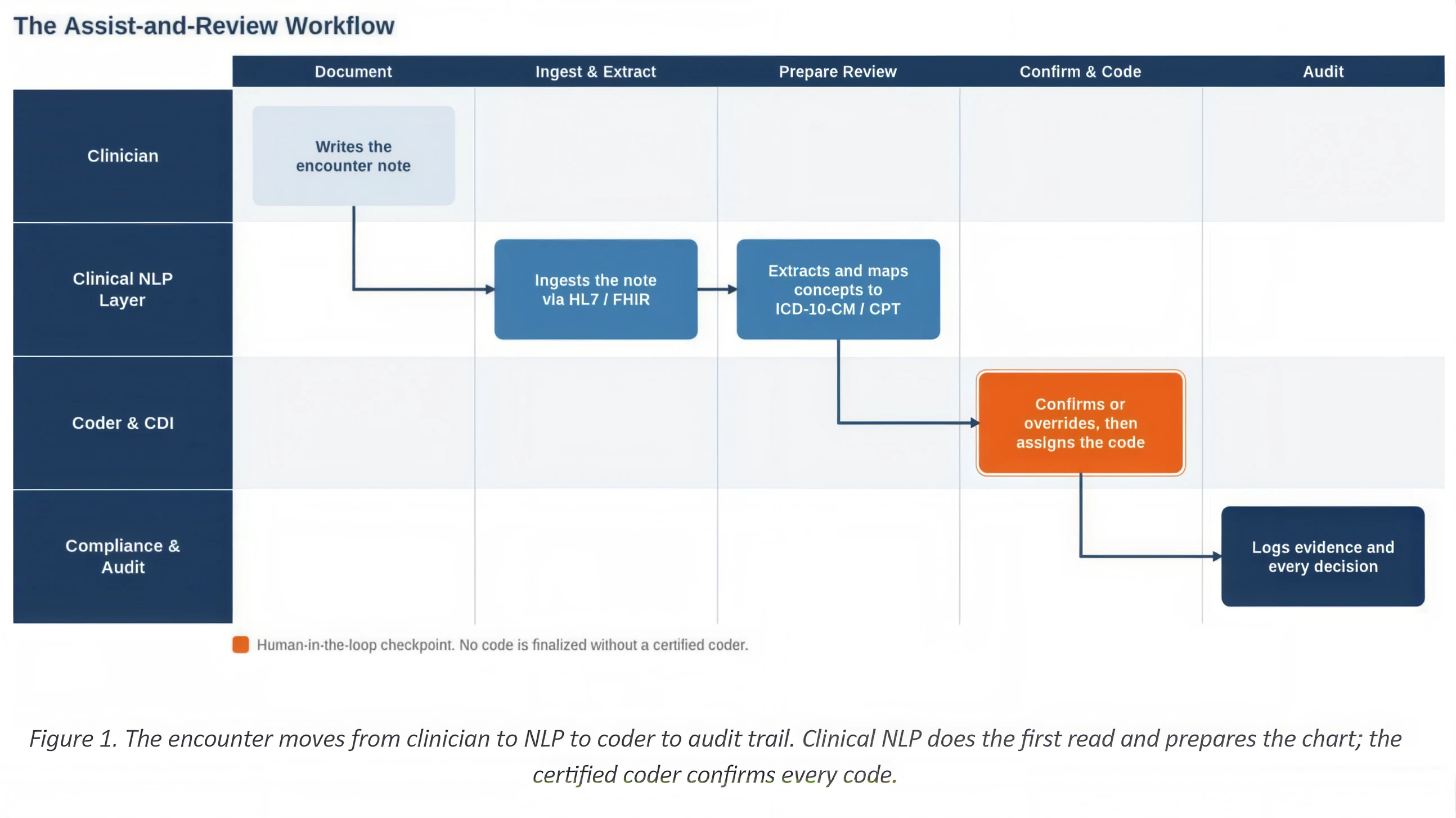
Nalashaa's team designed a clinical NLP layer that reads each note first and surfaces the coding-relevant evidence to the reviewer, rather than replacing the reviewer. The coder opens a chart that is already organized around the decisions they need to make, then confirms or overrides. This is an assist-and-review model, not autonomous coding.
-
01 / Extraction
Clinical NLP Extraction Layer
A clinical NLP pipeline parsed each incoming note and extracted problems, diagnoses, procedures, medications, and the surrounding context that supports them. Extracted concepts were normalized and mapped to standard terminologies to line up with ICD-10-CM and CPT assignments.
-
02 / Evidence Linking
Evidence-Linked Review View
Rather than a bare list of suggested codes, the interface presented each candidate's concept alongside the exact sentence in the note that supports it. The coder could see the basis for every suggestion at a glance, which kept trust high and made overrides fast.
-
03 / Human Oversight
Human-in-the-Loop by Design
No code was finalized by the system. The NLP layer prioritized and pre-organized the chart, and a certified coder made the final call on every encounter. CDI specialists used the same view to spot documentation gaps worth a query.
-
04 / Integration & Audit
Standards-Based Integration and Audit
Notes were ingested through the group's existing interfaces using HL7 and FHIR, so no clinician workflow changed. Every suggestion, along with its supporting evidence and the reviewer's decision, was logged to give the compliance team a complete, audit-ready trail.
Implementation Approach
The engagement started with a measured baseline. Before any tuning, Nalashaa timed the team's chart review and set a reference point of about 17 minutes per multi-page encounter note for the whole project. The NLP models were then calibrated against the group's own notes and specialties, because extraction quality on real local documentation determines whether reviewers save time.
The rollout was deliberately staged. A pilot cohort of six coders worked with the evidence-linked view for four weeks. Their feedback tuned the concept extraction and the layout, and the tool reached the full coding team within about ten weeks of kickoff. Keeping the coders close to the tuning loop is what moved the tool from technically accurate to genuinely faster in daily use.
-
01 — BASELINE
~17 min / note
Nalashaa timed the team's chart review before any tuning, setting the project's reference point.
-
02 — CALIBRATION
Local tuning
NLP models were calibrated against the group's own notes and specialties.
-
03 — PILOT
6 coders, 4 weeks
Pilot feedback tuned concept extraction and the layout.
-
04 — ROLLOUT
~10 weeks total
The tool reached the full coding team within about ten weeks of kickoff.
Solution Highlights
-
Reading Time Moved Off the Coder
The NLP layer did the first read. Coders arrived at a chart already organized around the coding decision, which is where the review-time reduction came from.
-
Every Suggestion Traceable to the Note
Evidence of linking meant reviewers never had to take a suggestion on faith. That transparency is what made the team comfortable relying on the assist.
-
Coders Stayed in Control
Because the model assisted rather than decided, accuracy and accountability stayed exactly where they belonged, with the certified coder.
-
No Change Asked of Clinicians
Standards-based ingestion meant the people writing the notes never had to do anything differently, which removed the usual adoption of friction.
Benefits
~30%
Less chart review time (about 17 to 12 min)
+6
More charts per coder each day
~85%
NLP suggestions accepted without change
| Benefit | Description | Impact Metric |
|---|---|---|
| Faster pre-coding review | NLP surfaced coding-relevant evidence up front, so coders spent less time reading full notes. | ~30% less review time |
| More charts cleared | Reduced reading time per chart raised how many encounters the same team could process in a day. | Higher daily throughput |
| Accuracy preserved | Final assignment stayed with certified coders, with every suggestion linked to note evidence. | Reviewer-confirmed coding |
| Audit-ready by design | Suggestions, evidence, and reviewer decisions were logged end-to-end. | Full HIPAA-aligned trail |
The Takeaway
The most useful decision in this engagement was defining the problem as a reading problem, not a coding problem. The team did not need a machine to assign codes for them. They needed the reading done first so their expertise could go to the decisions that actually require judgment.
For provider groups and coding operations under volume pressure, that is often the fastest, safest win from AI in the revenue cycle. Let clinical NLP organize the chart and keep the coder in charge of the code.
See where NLP would save your coders the most time.
Let's baseline your chart review.
Talk to the experts